
The diminished states
Once key powerbrokers in north-east Africa, Egypt and Somalia are now shadows of their former selves as they attempt to revive an old alliance.
This article was originally published on the Geeska website in July 2025. You can read the original here.
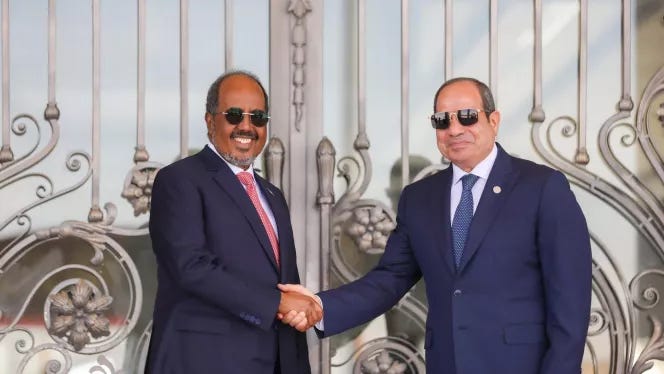
Somalia’s president, Hassan Sheikh Mohamud, visited Egypt last July for the fourth time during his term. He has visited the country more than any other president since the re-establishment of the Somali government, aiming to rekindle a relationship that was important in the second half of the 20th century in northeast Africa, but now appears far less consequential. Back then, Cairo and Mogadishu, ruled by revolutionary military governments, sought to balance Israel and Ethiopia respectively, with whom both had complex and contentious relations. They were also important regional actors, driving local cold war dynamics and shaping the geopolitics of the Red Sea, one of the world’s most important trade routes.
The importance of this region has been more recently underlined with Israel’s recognition of Somaliland, and the tussling between Saudi Arabia and the United Arab Emirates for regional preeminence.
Today the scope of the relationship between Egypt and Somalia is much narrower, as Cairo attempts project strength against Ethiopia which has built a major dam across the Nile and Somalia seeks new allies to augment its drawn-out state-building process and balance Ethiopia’s unchallenged influence across the Horn of Africa. Both have been on the back foot for the better part of the last two decades and have been playing catch-up. Former Assistant Foreign Minister of Egypt, Abdullah Al-Ash’al told The New Arab, that Egyptian influence had “waned openly due to the lack of vision”. In his view that needed to be immediately corrected.
Somalia and Egypt began reviewing their relationship in earnest following the announcement at the start of 2024 of a memorandum of understanding between Somaliland and Ethiopia. The contents and scope of the memorandum were largely unknown to journalists, but it is generally understood to be an agreement that grants Ethiopia a strip of land along Somaliland’s coast for a naval base, in exchange for recognition of Somaliland’s 1991 declaration of independence from Somalia. The memorandum was thwarted by a Somali diplomatic blitzkrieg and Turkish mediation, but it would have seen both Somaliland and Ethiopia mutually facilitate the achievement of core aims for their respective leaderships.
The agreement alienated Somalia, which said the memorandum was an Ethiopian attempt to “annex” part of its territory. It began framing Ethiopia as a threat to its state-building process, despite Ethiopia’s significant role in Somalia’s security landscape, deploying large numbers of troops in the African peacekeeping mission and bilaterally in the fight against al-Shabaab. In the same month that the memorandum was announced, Somalia’s deputy prime minister, Salah Jama, for example, astonishingly told TRT World that al-Shabaab’s existence was a consequence of Ethiopia’s 2006 invasion of Mogadishu, which established the government he represents back in the capital.
These developments torched Ethiopia’s influence with Somalia’s federal government but have not succeeded in getting Ethiopia’s leadership to take Egypt’s concerns about the Nile more seriously or to back down on their demand for sea access.
This provided Egypt with an opportunity to begin expeditionary attempts to re-establish itself as a player in the Horn of Africa. Egypt previously tried in 2021 to cultivate ties with Nile basin countries but without reaping much fruit. Two days after Salah’s interview with TRT World, the Somali president made his first visit to Egypt, during which he secured Egyptian support for Mogadishu against Ethiopia. In August that year, Cairo and Mogadishu signed a mutual defence pact and Egypt offered to contribute troops to the African Union peacekeeping mission in Somalia. By September, it was sending weapons to the Somali army. Then, in October, Egypt and Somalia expanded their anti-Ethiopian front to include Eritrea, which has its own issues with Ethiopia, to coordinate their efforts against Addis Ababa.
While it is important not to exaggerate the potential impact of these developments, Cairo is reshaping the geopolitics of the Horn of Africa to ensure that Abiy Ahmed, Ethiopia’s prime minister, doesn’t have as free a hand in Somalia as his predecessors have had, thereby gaining some leverage with Addis Ababa. Egypt’s president, Abdel Fatah al-Sisi, previously appeared to be relying on a promise from Abiy, that he wouldn’t cause harm to Egypt through the Nile, which provides more than 90% of the country’s fresh water supply.
These developments torched Ethiopia’s influence with Somalia’s federal government but have not succeeded in getting Ethiopia’s leadership to take Egypt’s concerns about the Nile more seriously or to back down on their demand for sea access. Ethiopia’s unofficial state think tank, Horn Review, for example, has been publishing provocative policy proposals that its authors believe will help re-establish its navy.

This is partially a reflection of the diminished state in which Somalia and Egypt find themselves today. Ethiopia feels emboldened to behave in a manner that, as Djibouti’s president Ismail Omar Guelleh told Jeune Afrique, jeopardises the existence of its neighbours in the pursuit of its goals. Ethiopia, which once saw itself as a victim of Somali and Egyptian aggression, is now, in the view of leaders in both countries, supposedly posing a threat that they are struggling to contain.
In the 1950s, Gamal Abdel Nasser, Egypt’s then president, was a towering figure across Africa, backing and hosting anti-colonial movements, while also leading the Arab charge against the US and Israel in the Middle East. Cairo also backed Somalia’s push for independence from British and Italian rule, through its aggressive nationalist radio broadcasts and via one of its diplomats stationed in Mogadishu. Somali nationalists found a willing non-Western ally in Nasser, who was all too keen to support their demand for a portion of Ethiopian-controlled, but Somali-inhabited, Ethiopia, as well as their claims to territories either directly controlled by European empires (Djibouti) or their local allies (Kenya). But their “main antagonist” was the Ethiopian empire, writes Italian historian, Antonio M. Morone, where “Somalis and Egyptians converged in their perception”.
The Ethiopian emperor, Haile Selassie, feared Nasser, spending much of the 1950s avoiding the Egyptian leader’s invitations and expressing concern about his flagrant interference in the internal affairs of other Arab monarchical regimes and his backing of Eritrean separatists. In 1957, Selassie told a British journalist from The Telegraph that “Colonel Nasser” was “trying to stir up the large Muslim minority with the aim of dismembering this Christian kingdom.” This was great from the perspective of Somali nationalists who wanted their piece of Ethiopia too. I spoke a few months ago to a man who was tasked with liaising between the Somali government under Siad Barre and Ethiopian rebel groups. He told me the Somali government backed different armed groups, almost indiscriminately, to the hilt.
This Somali-Egyptian cooperation developed after independence for Somalia in 1960. Ethiopia was the West’s principal ally in Africa receiving generous support from Washington, which meant Somalia lagged behind in the quality of its weapons and the size of its army. Ethiopia was East Africa’s unchallenged regional hegemon, cornering Somalia. In a 1976 interview with the Egyptian magazine Rose al-Yusuf, Siad Barre, then Somalia’s military leader, recalled a visit to Cairo in the early 1960s as part of a Somali delegation, in which he represented the army, after Mogadishu had struggled to make its case in Europe for arms. Barre said that Nasser embraced the Somali delegation, offering his support and advising them to explore ties with Moscow, Cairo’s early cold war patron. The meeting “dispelled all despair and instilled hope,” Barre said.

The Ethiopian emperor, Haile Selassie, was so dismissive of his neighbours and so concerned about Nasser’s influence in relation to Somali claims to the Ogaden that he told a visiting Moshe Dayan in 1960, then an Israeli agriculture minister, that “the Somalis would have never dreamt of such an idea without being incited by Nasser”. The Ethiopian leader can be accused of misleading Dayan here, but his comment was more reflective of his concern about Nasser’s influence in the Horn of Africa than it was a statement of fact. In any case, the Somalis were grateful for Egypt’s support.
Somalia sought to repay the favour by siding with Egypt in the Six-Day War in 1967, committing to military intervention against Israel. The decision bewildered Somali politicians who wondered what value the move would have for Egypt, and whether the government had thought through the types of opponents it would mobilise.
A military coup in Somalia in 1969 brought to power a government that resembled Nasser’s Egypt. The new elites, as in Egypt, were soldiers. They were also socialists who were suspicious of the left. The grievances of leaders in Egypt and Somalia were rooted in dissatisfaction with their borders, which led both Mogadishu and Cairo to attempt to position themselves at the centre of transnational projects to radically alter regional cartographies and bring about a Greater Somalia and Arab unity. One Egyptian magazine even reported Barre as saying the Somali revolutionary government was a “legitimate and loyal daughter” of the “the revolutionary thought of leader Gamal Abdel Nasser”. By 1974, Somalia had joined the Arab League, with Egyptian backing.

The cold war realignment after Egypt defected to the West from the USSR did not affect Somali-Egyptian relations in 1973, despite Somalia remaining the Soviet Union’s principal African partner. Egypt remained concerned about Ethiopia, despite the overthrow of Selassie’s imperial regime, and Somalia still had hostile relations with its neighbour. The foundational principles of Cairo’s partnership with Mogadishu were still sound, and that was clear from Egypt’s arming of the Somali military when it invaded Ethiopia in 1977. Mogadishu had loaded its arsenals with Soviet hardware and had built one of sub-Saharan Africa’s most formidable armies. When Somalia became hard-pressed for arms during the Ogaden war, an Egyptian diplomatic source told The New York Times that Egyptian planes carrying arms had been sent from Cairo to Mogadishu every day. In January 1978, The Washington Post reported that the West German government was financing the sale of Soviet arms from Egypt’s arsenals to the Somalis, who had severed their ties with Moscow in November over its reluctance to stop supporting Ethiopia. The relationships between Somalia and Egypt on the one side, and Ethiopia and Israel on the other, were so robust that Israel even found itself aligned against the US in the Horn of Africa when Somalia fell out with the USSR and sought ties with Europe and the US.
The US directed Somalia to seek ties with its Middle Eastern partners, but this failed to stem the tide of Somali decay and eventual collapse...
In the 1980s, the two countries found themselves on the same side in the cold war, though Somalia was not in as strong a position as Egypt, which had a new leader, Anwar Sadat; had moved more enthusiastically towards opening its closed economy to commerce and international trade; and had normalised ties with Israel with whom it fought several wars. Siad Barre explore the idea of a possible relationship with Israel but that didn’t get very far.
Siad Barre visited Ronald Reagan in Washington in 1982, but it wasn’t a fruitful meeting. The US directed Somalia to seek ties with its Middle Eastern partners, but this failed to stem the tide of Somali decay and eventual collapse, as the country lacked the support of a superpower patron, adequate aid, and was burdened by ongoing hostilities with Ethiopia and Ethiopian-backed rebel groups, which drained state resources. Somalia collapsed in the early 1990s. Egypt sent 1,600 troops to be part of the UN peacekeeping operation but the mission failed.
In Egypt, where military rule was re-established following the 2013 ousting of Mohammed Morsi, the country finds itself surrounded on all sides by neighbours where conflicts are being shaped by small regional countries operating in ways that contradict its interests.
Egypt would grow wealthier through the 1990s and 2000s, ahead of the Arab Spring, but as Somalia descended into chaos it remained a culturally important Arab country but a foreign policy minnow. It does however host a very large Somali diaspora. Following the Arab Spring which rocked Egypt, Marc Lynch, a professor at George Washington University, and specialist on the Middle East, said the regional order dominated by republican and nationalist military regimes, had given way to a region dominated by tiny oil-rich wealthy Arab monarchies. “The traditional great powers—Egypt, Iraq, and Syria—are now barely functional states. Wealthy and repressive Gulf countries—Qatar, Saudi Arabia, and the United Arab Emirates—are thriving,” Lynch wrote in Foreign Affairs.
In Egypt, where military rule was re-established following the 2013 ousting of Mohammed Morsi, the country finds itself surrounded on all sides by neighbours where conflicts are being shaped by Gulf countries operating in ways that contradict its interests. The UAE is backing the paramilitary Rapid Support Forces in Sudan as they attempt to overthrow the Sudanese army; Israel is waging a genocidal war in Gaza and has suggested pushing Palestinians into the Sinai; and in Libya, though Egypt has had limited success in projecting power, it plays second fiddle to the UAE, Turkey, and Russia. This analysis also overlooks the dire state of the Egyptian economy, which now relies on periodic IMF, Emirati or Qatari bailouts to stay afloat.
Meanwhile, Somalia continues to struggle to rebuild state institutions despite foreign backing, while battling an al-Shabaab insurgency that has gained momentum since announcing a new offensive early last year. More broadly, aid—which has been both a humanitarian lifeline for the Somali public and a crucial source of funds for the Somali government, is being cut. There is “donor fatigue,” as Ahmed Soliman, Horn of Africa Programme researcher at Chatham House, tells The Independent, with Somalia failing to make the kind of progress its backers want to see. Somali elites remain deeply divided on how the country should be governed, all while a widespread awareness of corruption and cronyism in Mogadishu persists. Important questions are being raised about the sustainability of the current status quo.
Mogadishu and Cairo’s budding new relationship is unfolding in a context where elites in both countries have less capacity than ever to shape developments in their region. It isn’t clear how Somalia can be of any help to Egypt on the Nile issue, or even whether arming Somalia or joining its mission against al-Shabaab necessarily strengthens Egypt’s negotiating position. This isn’t to suggest that Ethiopia fares much better, but the frequent meetings between the two, and increased cooperation. feel more like gatherings greatly diminished states, rather than a new high-powered alliance between what were once two of the most important countries in northeast Africa.